Thoughts

The problem of human trafficking

Shenzhen Police Crack Down On Prostitution And Gambling

Human trafficking is a practice I condemn deeply, particularly the practice of sex trafficking or sexual slavery, because it could have touched very close to home. My wife went to college in the city of Constanta, Romania, which is one of the main cities in the country where abductions and other crimes of sex trafficking occur. When we met, she still had about two years before graduation. Because we were apart for long periods of time, and she was and is very beautiful, I had this constant fear of her being a target for sex traffickers. Thank goodness nothing happened.

My fear may sound absurd to you, but it was real to me, and it’s real to the parents of girls in that city and in other large Romanian cities. Constanta in particular, being a port city on the Black Sea, invites a lot of unwanted attention from criminals of all varieties. Girls are routinely abducted there and carried off to Middle-Eastern countries, where they’re either made part of some filthy Arab’s harem or forced into prostitution.

Romania is one of the major trafficking source countries for women and children in Europe, among others such as Albania, Moldova, Bulgaria, Russia, Belarus and Ukraine. Just next door to Romania, the Republic of Moldova, Bulgaria and Ukraine also have the dubious distinction of being among the main trafficking sources for the world, along with Thailand, China, Nigeria, Albania, and Belarus. So you see, the entire Eastern Europe region around the Black Sea is a hot spot for human trafficking. I’m not saying this of myself, but many statistics bear this out. Check out the reference links at the bottom of this article and see for yourselves.

Girls and children abducted or manipulated into going abroad may be taken through a transit country like Mexico or Israel, or end up in a destination country, which is usually rich enough for the “customers” to be able to afford the human trafficking “products”. The list of the biggest destination countries is as follows: Thailand (also a major source), Japan, Israel (also a transit country), Belgium, the Netherlands, Germany, Italy, Turkey and the US.

After talking with people in Romania, I found out that a lot of girls from the country end up in Germany and Turkey. Not all are physically coerced into going there. Criminals exploit lack of opportunities, promise good jobs or opportunities for study or marriage, and then force the victims to become prostitutes, or they may abduct them outright. Through agents and brokers who arrange the travel and job placements, women are escorted to their destinations and delivered to the “employers”. Upon reaching their destinations, some women learn that they have been deceived about the nature of the work they will do; most have been lied to about the financial arrangements and conditions of their employment and find themselves in coercive or abusive situations from which escape is both difficult and dangerous. They are psychologically manipulated by skillful, experienced traffickers into the practice of prostitution and are kept in that lifestyle by any means necessary, such as continual psychological or physical abuse or drugs.

Another tactic is for a trafficker to seduce a girl, pose as a couple as they go abroad, then, while the girl is still in love with him, get her to sleep with other men in order to make money while they “start from scratch”. He’ll keep saying he can’t find a job yet, she’ll keep sleeping with other men for money, and before she knows it, she’s a prostitute, and he’ll waste no time calling her one, each and every day, beating her down psychologically till she’s too broken down to resist the sordid lifestyle. When she’s broken, there’s no need for the captor to pretend they’re a couple, so he’ll revert to the job of an outright pimp.

The girls’ families usually know nothing of their girls’ whereabouts and doings. The girls tell them they’re going abroad for jobs, then, when they’re already caught in the web of prostitution, will lie to them and tell them they’re working somewhere, out of shame for what they’re doing. The girls are usually over 18, they’re going willingly, the police can do nothing about it, and once they’re abroad, it’s too late. Some people I talked to were pragmatic, even downright dismissive. “They’re old enough to know what they’re getting into,” they said. “If that’s what they want to do with their lives, it’s their business.”

The vile practice of human trafficking is a profitable one. People in Romania can usually finger the ones who are doing it, and can tell you how quickly they got rich, how many houses and cars they have, and so on. The sad part is that there’s little the police can do, unless abductions are involved. Even then, since the victims are taken to other countries, any moves require close cooperation with police forces in those countries, who may or may not care at all, so authorities are stuck.

Human trafficking is condemned and forbidden by the Protocol to Prevent, Suppress and Punish Trafficking in Persons, especially Women and Children (also referred to as the Trafficking Protocol), which is a protocol to the United Nations Convention against Transnational Organized Crime. The protocol defines human trafficking as “the recruitment, transportation, transfer, harboring or receipt of persons, by means of the threat or use of force or other forms of coercion, of abduction, of fraud, of deception, of the abuse of power or of a position of vulnerability or of the giving or receiving of payments or benefits to achieve the consent of a person having control over another person, for the purpose of exploitation.”

While the UN and many civilized countries condemn the practice, and many celebrities have signed on to the cause of fighting human trafficking, little headway is being made. In part, this is because collaboration between police forces in various countries is difficult, as few protocols with too few teeth are in place for this sort of thing. Also, governmental organizations set up for the purpose of fighting human trafficking are busy bickering among themselves over the definition of human trafficking. Finally, what makes this a difficult fight is that at least where sex trafficking is concerned, the majority of the girls go willingly, because they’re duped into it. Some are even okay with prostitution, though they may not be aware of the real working conditions until it’s too late.

Human trafficking is the fastest-growing criminal industry in the world. The US estimates the market at up to $9 billion, while the EU laughs at that estimate and states it to be around $42.5 billion. No country, rich or poor, civilized or not, is immune from the problem of human trafficking, which can take many forms, but is most often identified with the exploitation of women and children for the purposes of prostitution.Victims of traffickers are usually transported over state borders, though it’s not a pre-requisite, since they can be also coerced and manipulated in their own countries.

Still, good news exists when it comes to catching the criminals involved in this practice. Just a few years ago, while living in the DC area, I heard that a brothel disguised as a massage parlor, staffed by South-Asian women, was closed down, but not before the investigation revealed that prominent politicians and other men of supposed standing in the local community frequented the place, some quite often. In October of 2009, US authorities broke up a child prostitution ring where 52 children were recovered and 60 alleged pimps were arrested, during a three-day operation, tagged Operation Cross Country IV. Law enforcement actions were taken in 36 cities across 30 FBI divisions nationwide. It was part of the FBI’s ongoing Innocence Lost National Initiative, which was created in 2003 with the goal of ending sex trafficking of children in the United States.

The movie “Taken”, released in 2008, starring Liam Neeson, does a good job of showing what an abduction situation for the purposes of sexual trafficking looks like, how one can begin to tackle the situation, and how entangled the whole web of human trafficking really is, with many interested parties holding significant stakes in the matter, including the police, who are often on the take in order to turn a blind eye toward the matter. In the movie, Brian Mills, the main character, manages to track and save his daughter as she is exchanged through the hands of several captors, though in real life, this seldom happens. I’m not knocking the movie — I loved seeing all those sex traffickers get maimed, tortured and killed, because it’s what should happen to all of them — but the people who do this usually prosper while countless women, children and men suffer at their hands.


“Taken” (2008) Trailer – YouTube

The Vancouver Film School also put together a short documentary about human trafficking, which they recently released to the web.


“Traffic” (2009) – Vancouver Film School

In the end, I think the problem of human trafficking can be tackled along multiple avenues:

  • Prostitution and other forms of human trafficking should be made illegal. On one hand, I can understand arguments for making prostitution legal, such as the ability to provide medical care to prostitutes and to check on things a little better. On the other hand, you’d be legalizing a business whose product is the exploitation of women as sex objects. A bad practice shouldn’t be made legal just because some people choose to engage in it.
  • The burden of the punishment for human trafficking should be on the shoulders of those who are behind the scenes — not the prostitutes or human slaves themselves, who should be helped to reintegrate into society — but those who organize the business of selling them to the public and “recruiting” them. The human traffickers themselves should bear the heaviest legal punishments that can be meted out, probably on par with murderers. The clients themselves should have to pay significant fines if caught trying to solicit prostitutes or purchase human slaves. Heavy fines are a great deterrent for this sort of thing.
  • So that the bickering can stop over the definition of human trafficking and ways to combat it, separate organizations ought to be set up that deal with each category of offenses that have been grouped under this umbrella. In other words, sex crimes ought to have their own set of laws and organizations that fight them, and other kinds of human trafficking offenses ought to be separated under their own sets of laws and organizations. For example, I think someone that sells women as sex slaves ought to be punished differently and more severely than someone who sells men or women into indentured servitude, and someone who sells children into sexual slavery ought to be punished most severely.

These are just a few of my thoughts on the matter, but if you have anything to contribute, please comment below. For more information on human trafficking, please consult the following resources, on which I drew for facts and figures as I wrote this article:

Standard
Lists

Condensed Knowledge – October 25, 2009

This is a summary of articles I read and found interesting during this past week. The list is shared from among my feed subscriptions. I only share a certain number of articles in each of these posts, so if you'd like to see more, visit my full Google Shared Items list.

Standard
Reviews

Amazon Kindle now comes with international wireless coverage

amazon-kindle-3

The newly redesigned Kindle from Amazon now comes with both US and International wireless coverage built right in. This means you can use it as you travel in most of the civilized world and not have to worry about internet access. It’ll automatically find a wireless network it can use, you won’t pay anything extra, and it’ll let you browse and get books from Amazon, or deliver your daily newspaper and blog updates to you.

I checked to see if there was coverage in Romania, where I am at the moment, and sure enough, there is. Pretty cool.

kindle-coverage-romania

Having seen how clunky the 1st generation Kindle looked, I’m glad to see Amazon took the time to re-design it and to build in extra features like this one. Sure, it helps them too, since they get to sell more stuff to you, but I know just how annoying it can be to travel internationally and have to deal with different cellular plans. They put in the work needed to make sure the Kindle would just work wherever there was a serious wireless company available to provide coverage, and that’s definitely not something that happens overnight.

amazon-kindle-1

amazon-kindle-2

Standard
Reviews

Flickr launches People in Photos

Flickr launched a new feature they call People in Photos a few hours ago, on October 21, 2009. It lets you tag people in your photos or in your contacts’ photos. I guess it was only a matter of time before this happened. While Riya and iPhoto went the route of computer-aided facial recognition, which is a pretty cool feature indeed but processor-intensive, Facebook and now Flickr have gone the more low cost route of letting members manually tag people in their photos.

At any rate, the process is easy and real-time. You start typing in some identifier for a person you want to identify in a photo, such as a name or screen name or email address, the database of members is searched live, and you’re presented with a drop-down list of people that narrows down with each letter you type. Pretty cool. Flickr also went the extra mile and included the ability to let you determine who can add you to photos, and who can add people to your photos. Very nice touch there.

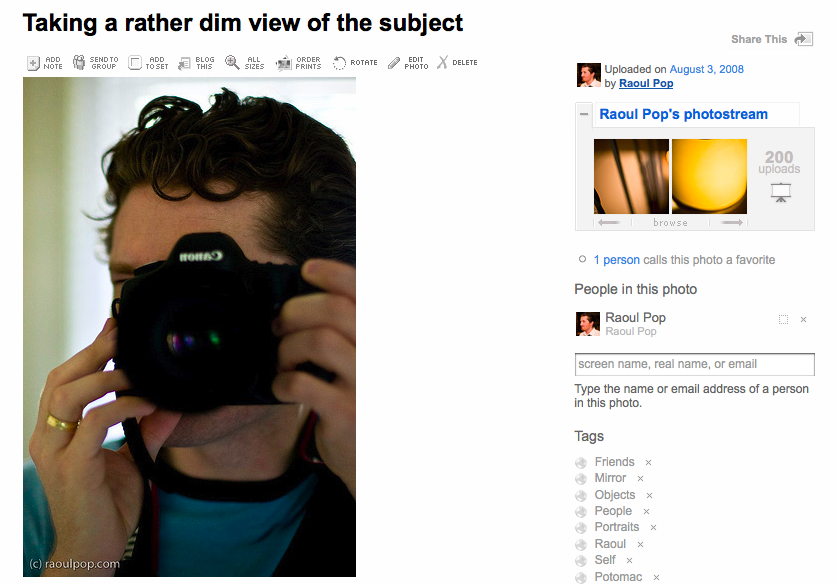
I added my wife and myself to a couple of photos where we appear, and took the following screenshots to show you what the new feature looks like. The only reason I noticed it is because I logged into my Recent Activity page a few minutes ago and saw a small change in the options, as you can see below.

flickr-people-in-photos-1

The option to add people to a photo is located in the sidebar, below the photostream and groups thumbnails and above the tags.

flickr-people-in-photos-2

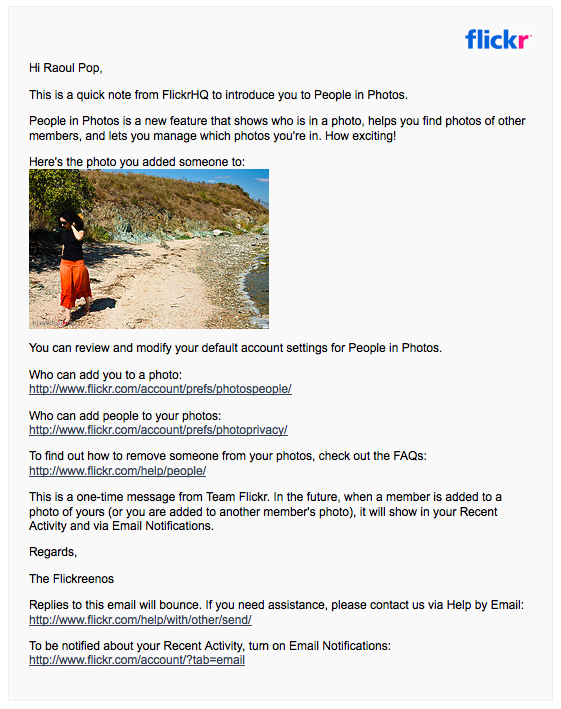
As soon as I got done tagging my wife and I in the photos, I got an email from Flickr where they explained the new feature to me and allowed me to set the privacy options I mentioned above.

flickr-people-in-photos-3

Like I said, pretty cool implementation, user-friendly, too, and it was something that was bound to happen sooner rather than later. There’s also a post on Flickr’s official blog announcing the feature launch.

What I’d like to know now is if Flickr can read the iPhoto person tags and somehow match them up with Flickr members, so that photos uploaded to Flickr from iPhoto get people-tagged automatically. Or is that the next step down the road?

Standard
Thoughts

Healthcare in Romania


There are two options for the person requiring care: the public healthcare system, financed by the government, where one is supposed to be cared for without cost if they hold medical insurance, and the private healthcare system, which is not really a system but is made up of different, unrelated private clinics or hospitals, where one must pay all expenses out of pocket. Let’s look at each system in more detail.

Public healthcare

I believe there are three main problems plaguing public healthcare in Romania:

  1. Widespread corruption at all levels of care. Bribes must be paid to hospital directors, managers, doctors and nurses, and sometimes even to hospital guards, if you are to get any competent care other than a daily temperature and blood pressure check until you check out or expire, whichever comes first.
  2. Incompetent personnel, due to:
    1. An inefficient medical education system, staffed with teachers and professors who care more about furthering their own careers, brown-nosing and getting bribes than teaching students how to be proper nurses and doctors.
    2. An unwillingness on the part of most students and medical personnel to put in the effort to acquire the knowledge they need to do their jobs right.
  3. Old facilities and equipment. Hospitals and clinics lack the funds to maintain the infrastructure properly, so all of them are run-down, cold in winter, hot in the summers, with drafty rooms and hallways where you’re likely to catch pneumonia, with bathrooms that have leaky faucets and leaky toilets, mostly left uncleaned, smelly, wet and old, with metal beds that date way back from the 1st or 2nd world war (I’m not kidding about this), and with mattresses that have seen more than their fair share of human bodies and bodily fluids. When it comes to equipment, it’s mostly non-existent, other than basic X-ray machines.

Sure, there are exceptions. There are some doctors and nurses who don’t ask for bribes. And there are some medical personnel who are competent at their jobs — they know how to do them and take the time and effort to put their knowledge to good use. But if you think the two groups contain the same people, you are probably mistaken. It’s usually the doctors who are the most competent that demand the bigger bribes, though it could be that a really good doctor or nurse may also be the one who doesn’t ask for or accept bribes. There’s no way to tell, really. It’s like taking a potshot in the dark. You’ll go to get some care and may end up with a butcher or a blundering fool who only makes things worse, and you may also end up paying him or her plenty of money for the shoddy treatment.

On some level, I understand why the corruption exists. Salaries for government-paid doctors and nurses are very low — janitors at profitable private businesses usually make more money than doctors in government hospitals — but that’s still no excuse for the endemic corruption. While salaries are low, medical personnel have also gotten used to asking for money from each and every patient, to the point where they expect it for the littlest thing and won’t help you if you don’t pay. There’s a ridiculous, infuriating sense of entitlement among most, if not all of them. Somehow they’ve gotten to think you owe them money simply for looking at you. That’s not right.

If only they’d take the time to study more, to get better at their craft, I, along with the millions of Romanians who visit hospitals, would feel better about paying extra to get care, but most are ignorant of any new developments in their fields. They only know enough to get by on routine matters. As soon as there are complications, they’ll take your money for a consultation, then tell you to go see this other doctor, who’ll ask for his share, then send you along to another, and so on and so forth until you’ve seen seven, eight, nine, ten doctors, have spent a month’s or two months’ salary on bribes, and you’re still no closer to getting treated right or cured. They’ll all nod their head, promise to help, take your money, run their tests, then scratch their heads and say they’re not sure what’s going on, that you’ll need to come see them again in a little while, etc., while happily fleecing you.

When it comes to government nurses, they won’t administer the injections or infusions or obey the doctors’ orders if you don’t slip them a bill, or some coffee, or chocolate, or whatever. It has to be something a little more expensive than just some candy or a trinket, and let me tell, when you’re being seen by four or five nurses and you need to make sure each of them gets something, it gets expensive. It’s so sad to visit hospitals and see all the old people on small pensions walk about with sad looks on their faces, mostly ignored by the nurses who are supposed to care for them, simply because they can’t afford to bribe them.

Private healthcare

There is hope when it comes to Romanian healthcare, and as is usual in a free enterprise system, it’s found in the private arena, where there are financial incentives for those willing to take some risks and make some investments in buildings, medical equipment and qualified personnel.

There are private clinics and hospitals, completely separate and unrelated to the government, where you can get competent care if you have the money to pay for it. Truth be told, it may end up costing you less than government healthcare if you add up all the extra costs involved with bribing government personnel.

Only the best doctors and nurses get hired in the private clinics and hospitals, are paid good salaries, are forbidden from taking bribes, and these facilities are equipped with the latest devices needed for proper patient care. There are entire hospitals and sanatoriums placed in beautiful locations in the mountains, where you can go to spend a few weeks to relax and get allopathic or natural, holistic treatments. There’s an entire gamut of options available to those willing to pay out of pocket.

For example, let’s say you need to run a whole battery of tests to see how your body is doing. You can go to the local government hospital, see and bribe a doctor to get some tests, then go to five or six different labs inside the hospital to run those tests, bribe your way through each place, then come back to the doctor in a few days to give him or her more money to look at the test results and tell you what’s going on. Or you can check into a private clinic, where for a fixed cost, you will spend a few days in a clean, private room with proper heating and cooling, pick your food from a menu, have your meals served to you, be able to take showers in a clean bathroom, be seen by caring, competent doctors and nurses, and get accurate test results interpreted properly. That’s the difference.

I should mention that private doctors’ offices aren’t the same thing as privately-run clinics and hospitals. Many government doctors also keep private offices, and will actually force people who come to see them in hospitals to go to their private offices and pay out of pocket to get the same care they could get for free in hospitals, but the care patients get there is just as bad as inside hospitals, and the facilities are usually just as unhygienic and inefficient. No, you must seek out professional private clinics and hospitals if you want to get the serious care I mentioned above.

Possible solutions

I think you know by now which option I would pick if I were to get sick in Romania, and for good reason. That’s not to say public healthcare can’t be fixed. In recent years, there’s been a serious push against corruption in Romania, at all levels of government, not just in healthcare, driven by the EU, but they haven’t made much headway other than talking about it and putting up posters in government agencies. Much more needs to be done, and it needs to start first with better salaries for medical personnel, probably double or triple what they are now.

Corruption in Romania is a very serious problem, one that requires an organization with teeth, one that can and does take immediate action against infractors, and where the identity of the person reporting incidents of corruption is kept top secret. Sadly, the system is still stacked against those willing to report it. Think for a moment what happens to someone who wishes to report a doctor who asks for money. First, they won’t get the treatment they need, and they may have an urgent medical problem, and then, if their identity is leaked, word about them spreads like wildfire, and no medical personnel at that hospital will want to treat them — and it may be the only government hospital or clinic in town. So people usually shut up and pay up, because they want to get on with their lives, not cause problems for themselves and for others.

Until the problems of corruption and salaries and public healthcare infrastructure get resolved, I would encourage people to use private healthcare options, if they can afford it. The more people use private healthcare, the more affordable and accessible it will get over time, and the more incentive there will be for the government to fix public healthcare.

Standard